How Drone Warfare Is Changing Modern Conflict
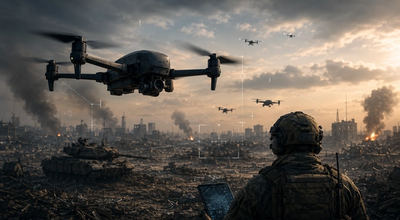
The technology, tactics , and systems reshaping modern warfare on the battlefield.
Key Takeaways
Cheap drones are changing the economics of warfare by destroying expensive military systems at extremely low cost.
Persistent aerial surveillance is making battlefields increasingly transparent and reducing traditional battlefield concealment.
FPV drones and loitering munitions are democratizing precision strike capabilities once limited to advanced militaries.
Electronic warfare, signal jamming, and spectrum control are becoming central parts of modern conflict.
Military power increasingly depends on industrial production, adaptation speed, and civilian technology ecosystems.
Autonomous systems and AI-enabled drone swarms could reshape future deterrence, urban warfare, and global security dynamics.
Cheap Machines, Expensive Consequences
In earlier eras of warfare, military power depended heavily on industrial scale. States needed factories, airfields, aircraft carriers, artillery production, fuel logistics, and large standing armies. Advanced military capabilities were concentrated among major powers because sophisticated weapons systems were expensive to design, manufacture, and operate.
Drone warfare is beginning to alter that equation.
Small unmanned aerial systems — ranging from consumer quadcopters to long-range autonomous strike platforms — are reducing the cost of precision attack, surveillance, and battlefield intelligence. Capabilities that once required billion-dollar air forces can now sometimes be replicated with commercially available electronics, improvised explosives, open-source software, and decentralized manufacturing.
The result is not simply a new weapon.
It is a structural shift in how military power is distributed, how wars are fought, how defenses are designed, and how states calculate deterrence.
The implications extend far beyond the battlefield.
Drone warfare is reshaping industrial policy, supply chains, urban defense, military procurement, geopolitics, electronic warfare, and even the economics of conflict itself.
The Long Monopoly of Air Power
For most of the 20th century, air power was among the most exclusive forms of military capability.
Maintaining an effective air force required:
- advanced aerospace engineering,
- pilot training pipelines,
- large maintenance systems,
- secure airbases,
- radar networks,
- expensive munitions,
- and vast fuel logistics.
Only major states could sustain these systems at scale.
Air superiority therefore became a defining feature of American military dominance after the Cold War. The United States and its allies could project power globally because they controlled the skies. Precision-guided bombs, stealth aircraft, satellites, and intelligence systems allowed Western militaries to destroy targets with extraordinary accuracy from long distances.
Smaller states and non-state actors had limited ways to respond.
Drones are beginning to weaken that asymmetry.
What Makes Drones Different
A drone is not a single technology category.
The term now includes:
- small commercial quadcopters,
- FPV (first-person-view) racing drones,
- loitering munitions,
- long-range strike drones,
- autonomous swarm systems,
- naval drones,
- underwater drones,
- and strategic reconnaissance platforms.
What unifies them is not their size or purpose, but their operating model:
they remove the human pilot from the platform itself.
That produces several important advantages.
Lower Cost
A modern fighter aircraft may cost tens or hundreds of millions of dollars.
A strike drone may cost:
- tens of thousands,
- thousands,
- or even hundreds of dollars.
FPV drones used in Ukraine are often assembled from commercially available components originally designed for hobbyist racing.
This dramatically changes attrition economics.
Destroying a $10 million armored vehicle with a $500 drone creates a radically asymmetric cost exchange.
Persistence
Drones can loiter for extended periods over a battlefield.
Unlike artillery shells or missiles, they can search for targets dynamically before striking.
This turns reconnaissance and attack into a continuous process rather than separate functions.
Reduced Political Risk
Losing a drone does not mean losing a pilot.
This lowers political costs for states conducting operations abroad and makes certain missions more acceptable to political leadership.
The absence of captured or killed pilots reduces escalation pressure.
Accessibility
Many drone technologies rely on:
- commercial electronics,
- civilian batteries,
- GPS modules,
- cameras,
- satellite communications,
- and consumer manufacturing ecosystems.
This makes drones unusually difficult to monopolize.
Unlike nuclear weapons or stealth bombers, drone capabilities diffuse rapidly across borders.
The Ukraine War: The First Large-Scale Drone War
The war in Ukraine has become the clearest demonstration yet of drone warfare’s transformative effects.
Both Russia and Ukraine deploy drones at extraordinary scale.
These include:
- reconnaissance drones,
- FPV attack drones,
- naval drones,
- long-range strike drones,
- artillery-spotting systems,
- electronic warfare drones,
- and loitering munitions.
The battlefield increasingly resembles a transparent surveillance environment where movement is constantly detected from above.
Concealment has become dramatically harder.
The Death of Battlefield Sanctuary
Historically, front lines contained areas of relative safety:
- rear logistics zones,
- artillery positions,
- command posts,
- armored staging areas.
Drones are eroding these sanctuaries.
Cheap aerial surveillance now allows forces to identify:
- troop concentrations,
- supply vehicles,
- trench networks,
- artillery systems,
- fuel depots,
- and moving armor in near real time.
Combined with precision strikes, this creates persistent vulnerability across large areas of the battlefield.
The result is a battlefield that is increasingly:
- transparent,
- continuously monitored,
- and highly lethal.
FPV Drones and the Democratization of Precision Strike
One of the most important developments in Ukraine has been the widespread use of FPV drones.
These are often inexpensive racing-style drones modified to carry explosives and controlled remotely through video feeds.
FPV systems effectively create low-cost precision-guided munitions.
Historically, precision strike required:
- advanced missiles,
- laser designation systems,
- sophisticated aircraft,
- and expensive sensors.
Now, precision attack can sometimes be achieved with:
- a commercial drone frame,
- a camera,
- batteries,
- radio equipment,
- and improvised munitions.
This changes the economics of tactical warfare.
A tank can no longer assume survivability simply because it is armored.
The Crisis of Traditional Armor
Modern armored warfare evolved around the assumption that tanks could survive most battlefield threats through armor protection, mobility, and combined-arms support.
Drones challenge all three assumptions.
Top-attack drone strikes exploit weaker armor areas.
Persistent aerial observation makes concealment difficult.
Cheap loitering systems allow repeated attacks against expensive platforms.
This does not mean tanks are obsolete.
But it does mean armored warfare is entering a new adaptation cycle.
Future armored systems may require:
- active protection systems,
- electronic warfare suites,
- drone defenses,
- signature reduction,
- autonomous escorts,
- and integrated anti-drone capabilities.
The tank is increasingly becoming part of a networked defensive ecosystem rather than an independently survivable platform.
Electronic Warfare Becomes Central Again
Drone warfare is also reviving the importance of electronic warfare.
Many drones depend on:
- GPS,
- radio links,
- satellite communication,
- and digital networking.
This creates vulnerabilities.
Both Russia and Ukraine heavily use:
- signal jamming,
- spoofing,
- electromagnetic interference,
- and drone interception systems.
Modern battlefields increasingly involve invisible contests over:
- spectrum dominance,
- communications resilience,
- navigation systems,
- and signal intelligence.
Electronic warfare, once considered highly specialized, is becoming a central layer of tactical operations.
Industrial Warfare Returns
Drone warfare is often described as futuristic.
In reality, it has also revived something old:
industrial attrition warfare.
Large-scale drone conflict consumes enormous quantities of:
- batteries,
- motors,
- semiconductors,
- cameras,
- explosives,
- radio systems,
- and replacement airframes.
Success increasingly depends on manufacturing scale and supply-chain resilience.
Ukraine’s drone ecosystem relies heavily on distributed production networks involving:
- startups,
- volunteer groups,
- decentralized workshops,
- foreign suppliers,
- and rapidly iterative engineering cycles.
The line between civilian tech ecosystems and military-industrial production is becoming less distinct.
This is one reason why China occupies such an important position in global drone manufacturing.
China’s Structural Position
China dominates major parts of the commercial drone supply chain.
Chinese firms control significant portions of:
- battery manufacturing,
- drone motors,
- cameras,
- electronics assembly,
- and consumer drone production.
The most influential commercial drone company globally is DJI.
This creates strategic complications for Western governments.
Modern drone warfare often depends partly on supply chains tied to geopolitical competitors.
As a result:
- domestic drone production,
- secure electronics sourcing,
- and defense-tech manufacturing
are becoming strategic priorities for many states.
Naval Drone Warfare
Drone warfare is no longer confined to the air.
Ukraine has demonstrated extensive use of naval drones against the Russian Black Sea Fleet.
These systems are relatively inexpensive compared to conventional naval platforms.
Yet they have forced a major navy to:
- relocate ships,
- alter operating patterns,
- increase harbor defenses,
- and rethink maritime security.
This may signal a broader shift in naval warfare economics.
Historically, naval power concentrated in expensive capital ships.
Autonomous maritime systems could increasingly threaten those assumptions.
The Rise of Autonomous Warfare
Most current drones still involve substantial human control.
But the trajectory points toward increasing autonomy.
Future systems may:
- identify targets automatically,
- coordinate in swarms,
- navigate without GPS,
- and adapt dynamically to battlefield conditions.
Artificial intelligence is likely to accelerate this trend.
The combination of:
- machine vision,
- autonomous navigation,
- distributed coordination,
- and low-cost manufacturing
could eventually produce highly scalable autonomous weapon systems.
This raises major ethical and strategic questions.
Who controls lethal decision-making?
How do escalation dynamics change when machines operate at machine speed?
What happens when autonomous systems become globally accessible?
Drone Warfare Favors Adaptability
One of the most important lessons from recent conflicts is that drone warfare evolves extremely quickly.
Innovation cycles occur in weeks rather than decades.
Units continuously adapt:
- frequencies,
- software,
- hardware,
- tactics,
- countermeasures,
- and production methods.
This differs sharply from traditional military procurement systems, which often operate on multi-year or multi-decade timelines.
The implication is profound:
future military effectiveness may depend less on possessing the most advanced platforms and more on maintaining the fastest adaptation cycles.
Military organizations increasingly resemble technology ecosystems.
The Psychological Effect
Persistent drones also reshape the psychological environment of warfare.
Constant aerial surveillance creates continuous exposure.
Soldiers may assume they are always being watched.
Rear areas feel less secure.
Movement becomes riskier.
This produces:
- exhaustion,
- caution,
- logistical friction,
- and sustained psychological pressure.
The battlefield becomes not only physically transparent, but mentally oppressive.
The Urban Future of Drone Conflict
Many future conflicts are likely to occur in dense urban environments.
Cities provide:
- concealment,
- infrastructure,
- civilian cover,
- and complex terrain.
Drones are particularly suited to these environments because they can:
- maneuver through narrow spaces,
- conduct localized reconnaissance,
- and target positions precisely.
Urban warfare may therefore become increasingly shaped by:
- autonomous systems,
- sensor networks,
- and persistent aerial observation.
This could make future cities both battlefields and surveillance environments simultaneously.
Why This Matters Beyond War
Drone warfare is not only changing military doctrine.
It is influencing:
- industrial policy,
- export controls,
- semiconductor strategy,
- communications infrastructure,
- AI development,
- and national security planning.
The distinction between civilian and military technology ecosystems is narrowing.
Commercial innovation increasingly drives military capability.
This is particularly true in:
- batteries,
- robotics,
- AI,
- telecommunications,
- optics,
- and autonomous systems.
Future geopolitical competition may therefore depend as much on industrial ecosystems and innovation networks as on conventional military inventories.
Signals to Watch
Several developments will shape the next phase of drone warfare:
Autonomous Swarms
Large coordinated drone groups operating with minimal human input.
Counter-Drone Systems
Electronic warfare, directed energy weapons, interceptor drones, and automated defenses.
AI Integration
Machine vision and autonomous targeting systems.
Domestic Manufacturing
Efforts by states to localize drone supply chains.
Naval Autonomy
Expansion of unmanned maritime systems.
Civilian Infrastructure Vulnerability
Energy grids, ports, logistics systems, and industrial sites becoming more exposed to low-cost drone attack.
Regulatory Fragmentation
Global disputes over export controls, software restrictions, and autonomous weapons treaties.
The Larger Transformation
Drone warfare represents more than a tactical evolution.
It is part of a broader shift toward:
- cheaper precision,
- distributed military power,
- autonomous systems,
- and industrialized digital warfare.
The monopoly on advanced military capability is weakening.
Precision strike is becoming more accessible.
Battlefields are becoming more transparent.
Adaptation speed is becoming more important.
And the line between civilian technology systems and military infrastructure is fading.
The countries that adapt fastest — technologically, industrially, organizationally, and strategically — are likely to shape the next era of conflict.
How Drone Warfare Is Changing Modern Conflict
The technology, tactics , and systems reshaping modern warfare on the battlefield.

Key Takeaways
Cheap drones are changing the economics of warfare by destroying expensive military systems at extremely low cost.
Persistent aerial surveillance is making battlefields increasingly transparent and reducing traditional battlefield concealment.
FPV drones and loitering munitions are democratizing precision strike capabilities once limited to advanced militaries.
Electronic warfare, signal jamming, and spectrum control are becoming central parts of modern conflict.
Military power increasingly depends on industrial production, adaptation speed, and civilian technology ecosystems.
Autonomous systems and AI-enabled drone swarms could reshape future deterrence, urban warfare, and global security dynamics.
Cheap Machines, Expensive Consequences
In earlier eras of warfare, military power depended heavily on industrial scale. States needed factories, airfields, aircraft carriers, artillery production, fuel logistics, and large standing armies. Advanced military capabilities were concentrated among major powers because sophisticated weapons systems were expensive to design, manufacture, and operate.
Drone warfare is beginning to alter that equation.
Small unmanned aerial systems — ranging from consumer quadcopters to long-range autonomous strike platforms — are reducing the cost of precision attack, surveillance, and battlefield intelligence. Capabilities that once required billion-dollar air forces can now sometimes be replicated with commercially available electronics, improvised explosives, open-source software, and decentralized manufacturing.
The result is not simply a new weapon.
It is a structural shift in how military power is distributed, how wars are fought, how defenses are designed, and how states calculate deterrence.
The implications extend far beyond the battlefield.
Drone warfare is reshaping industrial policy, supply chains, urban defense, military procurement, geopolitics, electronic warfare, and even the economics of conflict itself.
The Long Monopoly of Air Power
For most of the 20th century, air power was among the most exclusive forms of military capability.
Maintaining an effective air force required:
- advanced aerospace engineering,
- pilot training pipelines,
- large maintenance systems,
- secure airbases,
- radar networks,
- expensive munitions,
- and vast fuel logistics.
Only major states could sustain these systems at scale.
Air superiority therefore became a defining feature of American military dominance after the Cold War. The United States and its allies could project power globally because they controlled the skies. Precision-guided bombs, stealth aircraft, satellites, and intelligence systems allowed Western militaries to destroy targets with extraordinary accuracy from long distances.
Smaller states and non-state actors had limited ways to respond.
Drones are beginning to weaken that asymmetry.
What Makes Drones Different
A drone is not a single technology category.
The term now includes:
- small commercial quadcopters,
- FPV (first-person-view) racing drones,
- loitering munitions,
- long-range strike drones,
- autonomous swarm systems,
- naval drones,
- underwater drones,
- and strategic reconnaissance platforms.
What unifies them is not their size or purpose, but their operating model:
they remove the human pilot from the platform itself.
That produces several important advantages.
Lower Cost
A modern fighter aircraft may cost tens or hundreds of millions of dollars.
A strike drone may cost:
- tens of thousands,
- thousands,
- or even hundreds of dollars.
FPV drones used in Ukraine are often assembled from commercially available components originally designed for hobbyist racing.
This dramatically changes attrition economics.
Destroying a $10 million armored vehicle with a $500 drone creates a radically asymmetric cost exchange.
Persistence
Drones can loiter for extended periods over a battlefield.
Unlike artillery shells or missiles, they can search for targets dynamically before striking.
This turns reconnaissance and attack into a continuous process rather than separate functions.
Reduced Political Risk
Losing a drone does not mean losing a pilot.
This lowers political costs for states conducting operations abroad and makes certain missions more acceptable to political leadership.
The absence of captured or killed pilots reduces escalation pressure.
Accessibility
Many drone technologies rely on:
- commercial electronics,
- civilian batteries,
- GPS modules,
- cameras,
- satellite communications,
- and consumer manufacturing ecosystems.
This makes drones unusually difficult to monopolize.
Unlike nuclear weapons or stealth bombers, drone capabilities diffuse rapidly across borders.
The Ukraine War: The First Large-Scale Drone War
The war in Ukraine has become the clearest demonstration yet of drone warfare’s transformative effects.
Both Russia and Ukraine deploy drones at extraordinary scale.
These include:
- reconnaissance drones,
- FPV attack drones,
- naval drones,
- long-range strike drones,
- artillery-spotting systems,
- electronic warfare drones,
- and loitering munitions.
The battlefield increasingly resembles a transparent surveillance environment where movement is constantly detected from above.
Concealment has become dramatically harder.
The Death of Battlefield Sanctuary
Historically, front lines contained areas of relative safety:
- rear logistics zones,
- artillery positions,
- command posts,
- armored staging areas.
Drones are eroding these sanctuaries.
Cheap aerial surveillance now allows forces to identify:
- troop concentrations,
- supply vehicles,
- trench networks,
- artillery systems,
- fuel depots,
- and moving armor in near real time.
Combined with precision strikes, this creates persistent vulnerability across large areas of the battlefield.
The result is a battlefield that is increasingly:
- transparent,
- continuously monitored,
- and highly lethal.
FPV Drones and the Democratization of Precision Strike
One of the most important developments in Ukraine has been the widespread use of FPV drones.
These are often inexpensive racing-style drones modified to carry explosives and controlled remotely through video feeds.
FPV systems effectively create low-cost precision-guided munitions.
Historically, precision strike required:
- advanced missiles,
- laser designation systems,
- sophisticated aircraft,
- and expensive sensors.
Now, precision attack can sometimes be achieved with:
- a commercial drone frame,
- a camera,
- batteries,
- radio equipment,
- and improvised munitions.
This changes the economics of tactical warfare.
A tank can no longer assume survivability simply because it is armored.
The Crisis of Traditional Armor
Modern armored warfare evolved around the assumption that tanks could survive most battlefield threats through armor protection, mobility, and combined-arms support.
Drones challenge all three assumptions.
Top-attack drone strikes exploit weaker armor areas.
Persistent aerial observation makes concealment difficult.
Cheap loitering systems allow repeated attacks against expensive platforms.
This does not mean tanks are obsolete.
But it does mean armored warfare is entering a new adaptation cycle.
Future armored systems may require:
- active protection systems,
- electronic warfare suites,
- drone defenses,
- signature reduction,
- autonomous escorts,
- and integrated anti-drone capabilities.
The tank is increasingly becoming part of a networked defensive ecosystem rather than an independently survivable platform.
Electronic Warfare Becomes Central Again
Drone warfare is also reviving the importance of electronic warfare.
Many drones depend on:
- GPS,
- radio links,
- satellite communication,
- and digital networking.
This creates vulnerabilities.
Both Russia and Ukraine heavily use:
- signal jamming,
- spoofing,
- electromagnetic interference,
- and drone interception systems.
Modern battlefields increasingly involve invisible contests over:
- spectrum dominance,
- communications resilience,
- navigation systems,
- and signal intelligence.
Electronic warfare, once considered highly specialized, is becoming a central layer of tactical operations.
Industrial Warfare Returns
Drone warfare is often described as futuristic.
In reality, it has also revived something old:
industrial attrition warfare.
Large-scale drone conflict consumes enormous quantities of:
- batteries,
- motors,
- semiconductors,
- cameras,
- explosives,
- radio systems,
- and replacement airframes.
Success increasingly depends on manufacturing scale and supply-chain resilience.
Ukraine’s drone ecosystem relies heavily on distributed production networks involving:
- startups,
- volunteer groups,
- decentralized workshops,
- foreign suppliers,
- and rapidly iterative engineering cycles.
The line between civilian tech ecosystems and military-industrial production is becoming less distinct.
This is one reason why China occupies such an important position in global drone manufacturing.
China’s Structural Position
China dominates major parts of the commercial drone supply chain.
Chinese firms control significant portions of:
- battery manufacturing,
- drone motors,
- cameras,
- electronics assembly,
- and consumer drone production.
The most influential commercial drone company globally is DJI.
This creates strategic complications for Western governments.
Modern drone warfare often depends partly on supply chains tied to geopolitical competitors.
As a result:
- domestic drone production,
- secure electronics sourcing,
- and defense-tech manufacturing
are becoming strategic priorities for many states.
Naval Drone Warfare
Drone warfare is no longer confined to the air.
Ukraine has demonstrated extensive use of naval drones against the Russian Black Sea Fleet.
These systems are relatively inexpensive compared to conventional naval platforms.
Yet they have forced a major navy to:
- relocate ships,
- alter operating patterns,
- increase harbor defenses,
- and rethink maritime security.
This may signal a broader shift in naval warfare economics.
Historically, naval power concentrated in expensive capital ships.
Autonomous maritime systems could increasingly threaten those assumptions.
The Rise of Autonomous Warfare
Most current drones still involve substantial human control.
But the trajectory points toward increasing autonomy.
Future systems may:
- identify targets automatically,
- coordinate in swarms,
- navigate without GPS,
- and adapt dynamically to battlefield conditions.
Artificial intelligence is likely to accelerate this trend.
The combination of:
- machine vision,
- autonomous navigation,
- distributed coordination,
- and low-cost manufacturing
could eventually produce highly scalable autonomous weapon systems.
This raises major ethical and strategic questions.
Who controls lethal decision-making?
How do escalation dynamics change when machines operate at machine speed?
What happens when autonomous systems become globally accessible?
Drone Warfare Favors Adaptability
One of the most important lessons from recent conflicts is that drone warfare evolves extremely quickly.
Innovation cycles occur in weeks rather than decades.
Units continuously adapt:
- frequencies,
- software,
- hardware,
- tactics,
- countermeasures,
- and production methods.
This differs sharply from traditional military procurement systems, which often operate on multi-year or multi-decade timelines.
The implication is profound:
future military effectiveness may depend less on possessing the most advanced platforms and more on maintaining the fastest adaptation cycles.
Military organizations increasingly resemble technology ecosystems.
The Psychological Effect
Persistent drones also reshape the psychological environment of warfare.
Constant aerial surveillance creates continuous exposure.
Soldiers may assume they are always being watched.
Rear areas feel less secure.
Movement becomes riskier.
This produces:
- exhaustion,
- caution,
- logistical friction,
- and sustained psychological pressure.
The battlefield becomes not only physically transparent, but mentally oppressive.
The Urban Future of Drone Conflict
Many future conflicts are likely to occur in dense urban environments.
Cities provide:
- concealment,
- infrastructure,
- civilian cover,
- and complex terrain.
Drones are particularly suited to these environments because they can:
- maneuver through narrow spaces,
- conduct localized reconnaissance,
- and target positions precisely.
Urban warfare may therefore become increasingly shaped by:
- autonomous systems,
- sensor networks,
- and persistent aerial observation.
This could make future cities both battlefields and surveillance environments simultaneously.
Why This Matters Beyond War
Drone warfare is not only changing military doctrine.
It is influencing:
- industrial policy,
- export controls,
- semiconductor strategy,
- communications infrastructure,
- AI development,
- and national security planning.
The distinction between civilian and military technology ecosystems is narrowing.
Commercial innovation increasingly drives military capability.
This is particularly true in:
- batteries,
- robotics,
- AI,
- telecommunications,
- optics,
- and autonomous systems.
Future geopolitical competition may therefore depend as much on industrial ecosystems and innovation networks as on conventional military inventories.
Signals to Watch
Several developments will shape the next phase of drone warfare:
Autonomous Swarms
Large coordinated drone groups operating with minimal human input.
Counter-Drone Systems
Electronic warfare, directed energy weapons, interceptor drones, and automated defenses.
AI Integration
Machine vision and autonomous targeting systems.
Domestic Manufacturing
Efforts by states to localize drone supply chains.
Naval Autonomy
Expansion of unmanned maritime systems.
Civilian Infrastructure Vulnerability
Energy grids, ports, logistics systems, and industrial sites becoming more exposed to low-cost drone attack.
Regulatory Fragmentation
Global disputes over export controls, software restrictions, and autonomous weapons treaties.
The Larger Transformation
Drone warfare represents more than a tactical evolution.
It is part of a broader shift toward:
- cheaper precision,
- distributed military power,
- autonomous systems,
- and industrialized digital warfare.
The monopoly on advanced military capability is weakening.
Precision strike is becoming more accessible.
Battlefields are becoming more transparent.
Adaptation speed is becoming more important.
And the line between civilian technology systems and military infrastructure is fading.
The countries that adapt fastest — technologically, industrially, organizationally, and strategically — are likely to shape the next era of conflict.